
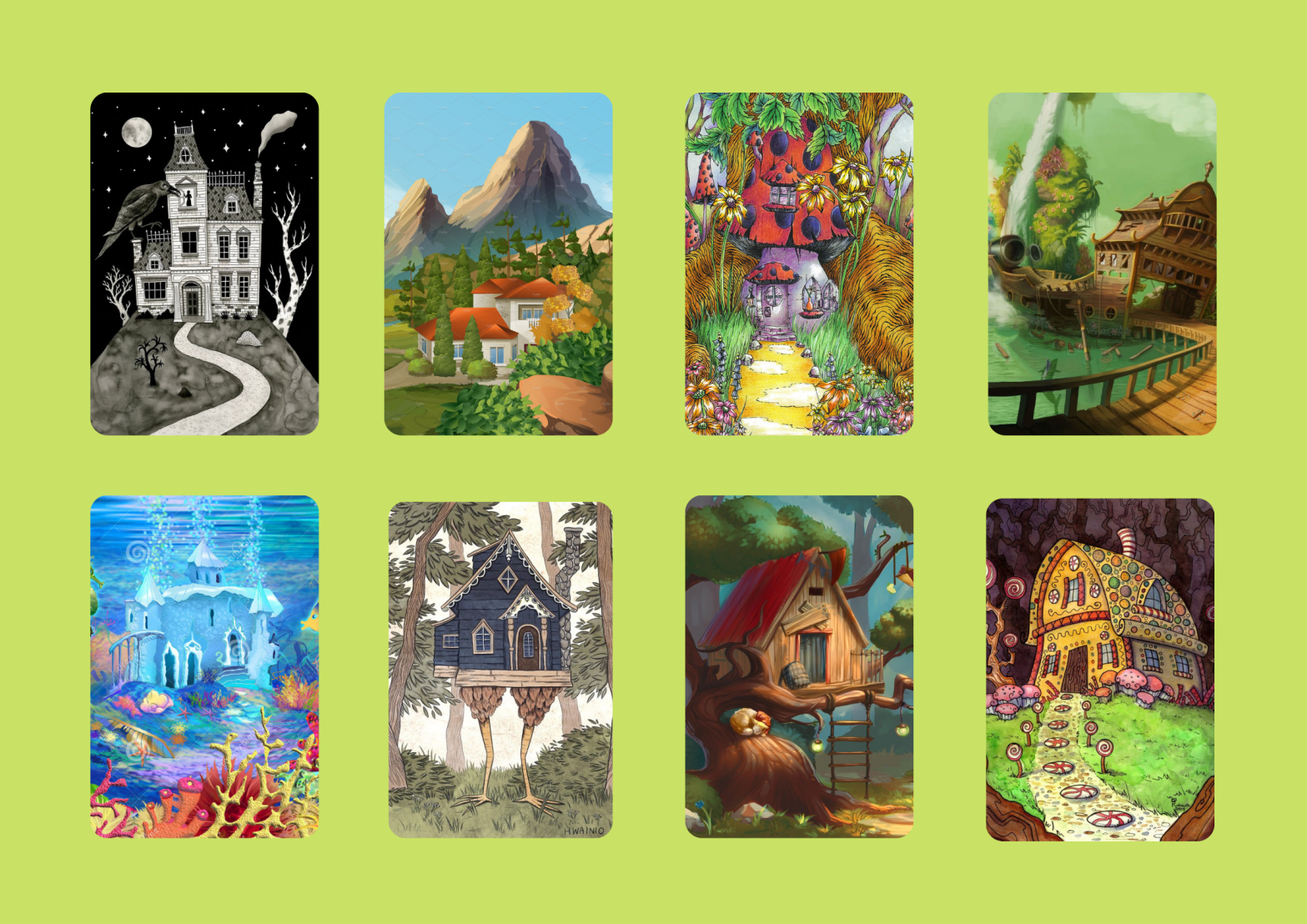
Once a month, Georgia and Miriam give themselves one hour to develop an original board game concept. Below is an overview of The House Hunt, our two-player co-op house hunting game.
THE ELEVATOR PITCH
The House Hunt is a co-operative challenge for 2 players. As a couple of adventurers in a light-hearted fantasy setting, you are searching for your perfect home. Players work together to earn a deposit and research the market, hoping to find and buy the fantasy house that will make them both happiest.
Important elements:
- Every turn is a choice between earning (adventuring) and research (viewing)
- Players each choose house attributes they prefer/dislike, and must work together and compromise for optimal score
- Randomness and risk in both sides of the game
THE LOOK
The game has a rich, colourful, chunky 3D cartoon aesthetic with strong fantasy theming. The box art shows a cottage on legs fleeing from a pair of adventurers with ranged weapons.
The components include:
- 48 House Cards
- 48 Quest Cards
- 16 Matrix Cards
- 6 Character Cards
- A pad of ‘Shopping List’ forms with columns for final scoring
- A cloth bag of additional Feature Tokens
- A Quest Die (six-sided die)
House Cards are beautifully illustrated and varied. Each card shows a single fictional house, with the whole deck showing a wide range of fantasy archetypes, settings and architectural styles. For example, a card might show an underwater coral palace, a treehouse, a wonky wizard’s tower or a haunted mansion. Each card also shows a price in Gold and up to five icons indicating different features of the property (such as location, size, or amenity elements).
Quest Cards are illustrated in a similar style with a darker palette. Each card shows a simplified representation of a quest, such as a dragon sleeping on a treasure hoard, a vampire terrorising a village or a fabled artifact resting in a treacherous place. Each card also shows a Gold reward for undertaking the quest, and a symbolic indication of the Quest’s Risk (explained below).
On setup, 16 House Cards and 16 Quest Cards are laid out in two separate, face-down 4 x 4 arrays on the table. The Matrix deck is shuffled and placed face down between them.
THE AIM
As a team, the players are aiming to find a house that will best fulfil their ideals and give them the highest satisfaction score at the end of the game. In order to buy a house, they need to earn enough Gold from adventuring to put down a deposit. Additionally, they can’t make a purchase until both players have “visited” the house they wish to buy.
At the beginning of the game, each player privately completes a ‘shopping list’ form for features of their dream home. Features fall into several categories such as Location, Amenity, and Size. Across all categories each player must choose multiple “Yes” features (marked with a smiley face) and “Maybe” features (marked with a neutral face). They also each choose one “No” feature (marked with a sad face) within each category. This information is shared during the game. Each player also chooses a Character Card which gives them an additional ability.
TURNS
There are 16 rounds, corresponding to the 16 matrix cards in the matrix deck. Each round, a matrix card is flipped which shows three card locations within a 4 x 4 grid. The corresponding cards in both the House array and the Quest array are turned face up. (The Matrix deck is designed so that each space in the 4 x 4 grid will show up three times throughout the whole deck.)
Each player must now take their turn, choosing whether to visit an available house, or go on an available quest.
Visiting a House: A player may choose to visit one of the face-up House Cards on their turn. The first time a house is visited, an additional Feature Token is drawn at random from the bag and placed on the House Card: the new feature is now a permanent part of that house. These tokens also mark the houses that have been visited once. Tokens are double-sided with two different coloured backgrounds, allowing the players to track which player has visited which house.
If a house which has been visited once is later visited by the other player, that House Card is removed from the array and placed to one side, in the “available market”.
Undertaking a Quest: A player may choose to undertake one of the face-up Quest Cards on their turn. When a quest is chosen, the players automatically receive the Gold reward printed on the card. The active player may then choose whether to take the “Quest Risk”: roll the Quest Die for a chance at an additional amount of gold on a certain result, but with the possibility of ‘going bust’ (losing all the gold from that quest) if the roll is undesirable.
Once a Quest has been taken once, its card is removed from the matrix and replaced with another Quest Card from the deck. Players keep completed Quest Cards in their ‘bank’ in one of three positions: portrait (for the base Gold amount), landscape (for the maximum Gold from a successful Risk roll), or face down (if the Risk roll went bust).
At the end of a round, all face-up cards in both arrays are turned over again, with feature tokens staying on their respective House Cards.
Examples of character card abilities:
- Barbarian: you may choose to undertake two visible Quests this turn, but must skip your entire turn next round.
- Rogue: once per game you may re-roll the Quest Die when undertaking a Quest.
SUMMARY
Players discuss and work together to balance the roles of earning (via Quests) and searching (via viewing Houses). They will likely need to strategise and compromise in order to gain access to houses that optimally meet their criteria from their Shopping List forms.
When the final round is concluded, players choose the house they want to buy. They must have the necessary Gold and the house must be in the “available market” (having been viewed by both players).
They will then calculate their individual and shared Satisfaction Score as follows:
- Two points for every “Yes” (smiley face) feature of their chosen house;
- One point for every “Maybe” (neutral face) feature;
- Subtract three points for every “No” (sad face) feature.
Players measure their Satisfaction Score against a scale to determine the level of their success, or how ‘well’ they have won.
WHAT’S UNIQUE ABOUT THIS GAME?
The House Hunt is a game which celebrates the ways two people can work together for a better shared life. From a light-hearted perspective it highlights the tough decisions and sacrifices that define the big moments in life as a couple.
- Private ‘shopping lists’ make the game personal to the players, and necessitate communication and compromise
- Whimsical fantasy house illustrations enrich the game with depth and heart
- Double card array system allows for complex meaningful decisions and smart forward planning
 Big Crow Games