
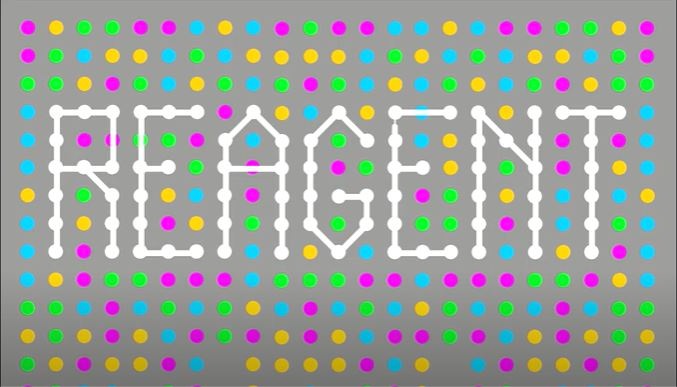
Crow Jam now has video episodes! Watch our first episode on Youtube. Below is an overview of our abstract tile-placement chemistry game, Reagent.
THE ELEVATOR PITCH
Reagent is a 2 – 4 player abstract tile placing game with a loose chemistry theme. Players are in a race of chemical formulae, competing to complete diagrams of various fictional molecules quickly and score the most points.
THE LOOK
The game is very tightly and simply designed, with a limited colour palette and consistency of pattern throughout. The components include:
- 4 player screens
- ~160 atom tiles
- ~80 molecular diagram cards, with three levels of difficulty (indicated on card backs)
- ~20 bonus objective cards
Player screens are short (10cm high, 20cm wide) opaque plastic upright screens with a small lip in the front containing slots for 3 cards.
Atom tiles are grey and divided into four invisible quadrants, each with space for one atom (represented by a dot). Each tile has a different combination and configuration of atoms (each dot either blue, green, yellow or purple) and blank quadrants. Molecular diagram cards come in three levels of difficulty – Easy, Moderate and Hard – which is indicated with a number on each card’s back. Each card has the light-hearted name of a fictional chemical, and shows a diagram of a target shape which uses 4 or more atoms in a set shape and colour arrangement. On the cards, these atoms are connected by white lines representing atomic bonds. Every diagram card requires at least 2 tiles to be used to replicate its pattern. All diagram cards also have a coloured border which corresponds to the majority atom colour within that molecule (e.g. green border for mostly green atoms, purple border for mostly purple atoms, or grey for no majority). A point value for completing the card is shown in the top right.
THE AIM
By placing tiles in a central map, players race to recreate molecular diagrams that they can see on their opponents’ cards. Each card they successfully complete first scores them points and introduces a new target card to play. They may also aim for bonus points from objective cards which require sets following certain rules. At the end of play, the player with the most points wins!
TURNS
On setup, each player places a screen in front of them with the card slots facing away. The molecular diagram cards are separated by difficulty and divided between players. A certain number are dealt face down to each player, creating a stack which increases in difficulty (e.g. 5 easy cards on top, 5 moderate cards below, 5 difficult cards on the bottom). Without looking each player draws the top 3 cards from their stack and inserts them into the screen facing away.
Each player draws 5 atom tiles from the central pile and looks at them. Each player also receives 2 bonus objective cards. These offer a bonus score for completing sets, e.g. a set of 3 green Easy molecules.
Play happens in turns. On their turn, a player draws up to 5 tiles in hand, then chooses a tile from their hand and adds it to the central map. At the end of their turn, if they can show that a pattern within the map exactly matches that on an opponent’s molecular diagram card that they can see, they may take that card and add it to their score pile. The player whose card it was replaces that card in their screen with another from their stack.
SUMMARY
Players take turns adding tiles to the map and advancing their attempts to complete molecule diagrams. As play goes on and the map gets larger, more opportunities emerge and larger scores can be gained from higher-difficulty cards. The game ends when one player’s card stack is depleted, at which point the round is finished and players total their points from molecular diagram cards and from any bonus objective sets they managed to get.
WHAT’S UNIQUE ABOUT THIS GAME?
Reagent is a fast-changing, quirkily competitive abstract tile game. It balances luck and long-term strategy and has plenty of tension as players hope to further their own goals in the shared map without helping others.
- Complexity and opportunity increase as the game goes on
- Hidden information (players cannot see at least some of the patterns their opponents are aiming for)
- Player choices can cause unexpected results
 Big Crow Games