
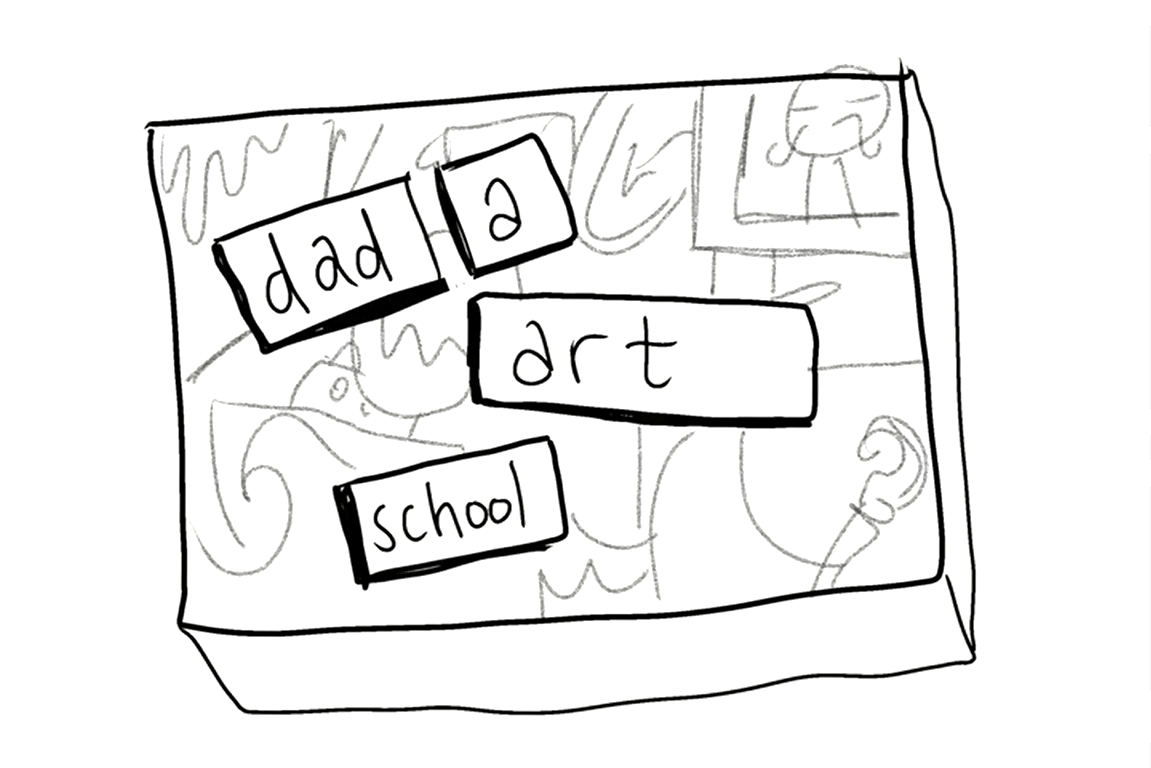
Crow Jam now has video episodes! Watch our second episode on Youtube. Below is an overview of our strange surreal art party game, Dada Art School.
THE ELEVATOR PITCH
Dada Art School is a co-operative artistic play experience for 3 – 6 players. With one player as the Artist, the group works together with different communication and contributions to create a surreal artwork. All players then collectively create an “exquisite corpse” poem inspired by the format of fridge magnet poetry.
THE LOOK
This is a game where art is generated by the players, and where most of the printed components are black and white to offset the colourful and imaginative nature of the outcome. The version we have imagined here is print-and-play, but a published version would use magnetic sheets.
The game includes:
~ 20 “magnet” cards
~ 12 “prompt” boards
~ shared words sheet (can be cut into multiple sections for convenience)
The game asks players to bring their own:
- Large sheets of art paper
- An easel or surface to display work on
- Good-quality and varied art materials
- 2+ pairs of scissors
- Glue
“Magnet” cards each show 21 unique words arranged in an array, much like you would see poetry fridge magnets from the packet. These words are varied but atmospheric, primarily nouns, adjectives, verbs and prepositions. The shared words sheet similarly carries common and short words (articles, prepositions etc.) that can be accessed by everybody.
A “prompt” board is split into two halves. One half contains a communication rule, such as:
- Every word you use must have three syllables
- You may not use words, only sounds
- You may only use direction words
The second half is empty, with space for one or more prompt words.
THE AIM
Each game, one player is chosen to be the Artist. Other players have prompts for images or concepts which should be included in the final artwork. Each player also has a rule which limits their communication. There is no hard “success” or “failure” condition, but the group should aim to have all prompts appear in some form in the final image. They then collectively create a poem from disparate sets of words.
To set up, the Artist stands in view of all players with their materials and work surface to hand. The shared words sheet is placed in the centre, while “magnet” cards are shuffled and dealt evenly to all players who are not the Artist.
From their magnet cards, each player chooses one or two words to use as a prompt and cuts/separates these out, attaching them to their prompt board. The rest of their magnet cards, including those which have been cut into, are retained in their play area for later. The prompt board now tells them exactly what they need to do in communicating with the Artist: an image (e.g. “full moon” or “fox”) that must be included in the artwork, and a rule which restricts their communication (e.g. “must speak in rhyming pairs of words”.) The golden rule is that none of the words on the board can be used when speaking. Players may not show their prompt board to other players.
TURNS
On their turn, a player communicates with the Artist in an attempt to have their image prompt added to the shared artwork. In general, they may try to give specific directions (e.g. “go to the top corner, and draw a circle” or they may try to indicate what their prompt is (e.g. “mischievous nocturnal animal” or “clear sphere, high sky, light night”) or use any tack as long as they do not contradict their communication rule. The artist will try to interpret their message and translate it into the artwork. The group may take multiple rounds if they choose to, either using multiple prompts, or adding detail and colour to initial sketches. However, at no point may anything be erased or removed from the artwork (editing or colouring over is permitted).
SUMMARY
When every player is happy with the shared artwork, players reveal their boards and assess the artwork. They will then collectively make a poem. Referring back to the magent cards in their play space, each player creates one or two lines of verse by cutting out and combining words. They may only use words that ae present on their own cards or words taken from the centre. Whenever they take a word from the centre, they must exchange it with one word from their own magnet cards.
These lines of poetry are combined into a final poem which reflects or describes the scene in the final shared artwork.
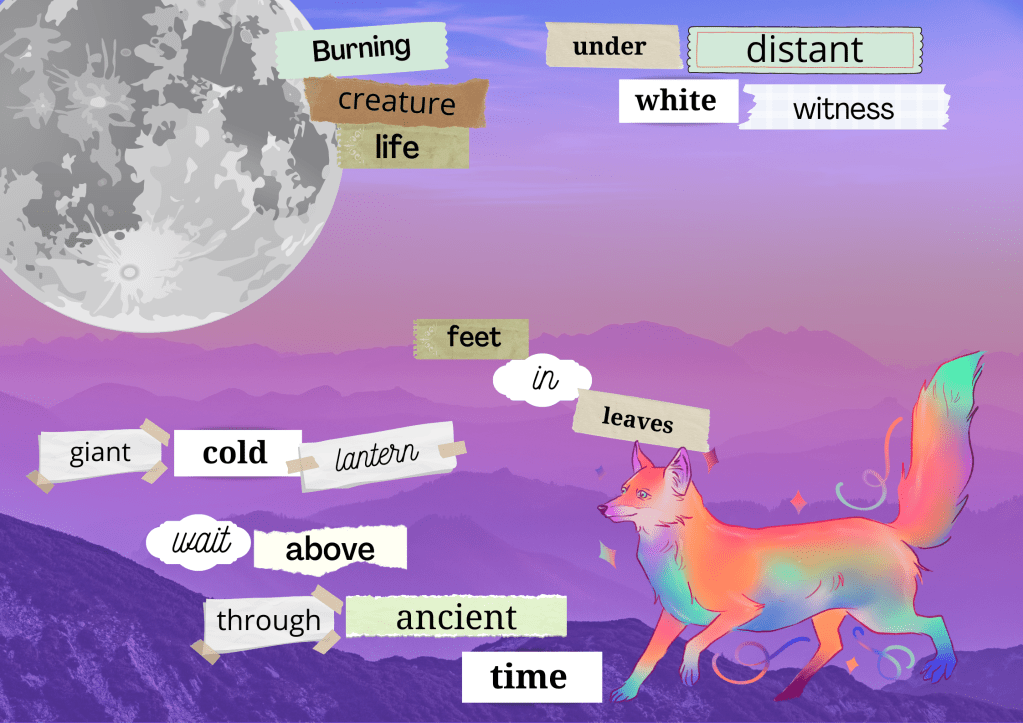
“Burning creature life,
Under distant white witness;
Feet in leaves,
Giant cold lantern
Wait above, through ancient time”
WHAT’S UNIQUE ABOUT THIS GAME?
Dada Art School is a shared artistic experience which uses play elements to create a separation and level of abstraction between artist and artwork, leaning into a surreal form of expression. By playing, the group creates a unique artwork. This piece captures a scene or emotion while also serving as a memento of the experience.
 Big Crow Games