

Crow Jam now has video episodes! Watch our third episode on Youtube. Below is an overview of our dreamlike tile-based co-op game, DREAM the WORLD.
THE ELEVATOR PITCH
DREAM the WORLD is a co-operative tile-based adventure game for 2 – 4 players. Players are walkers in a bizarre, shared dream scape, who must navigate the dream’s dangers and summon the means to save one another from its depths.
THE LOOK
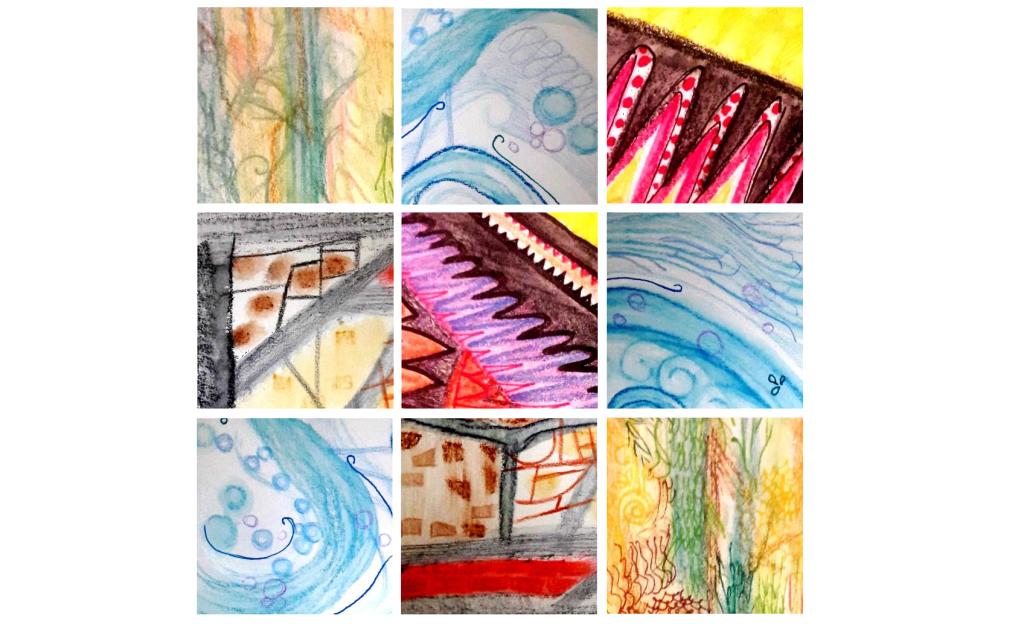
DREAM the WORLD consists largely of square tiles which are illustrated with abstract, dreamlike patterns and images. The feel of the illustration is loose and shifts between strange patterns, surrealist style, and the feel of AI-generated landscapes or abstract satellite imagery.
The game comes with player pieces to represent the players’ locations, but encourages players to replace these with their own “totem items” – small objects drawn from their own belongings, those with sentimental or symbolic meaning e.g. a wedding ring, keyring, button, or old coin.
The components include:
- ~150 Dreamscape tiles, including 5 Summoning Squares.
- 4 player totems in distinct colours/shapes
- 8 Anchor Stones, two in each player colour
- 12 Portal tokens
- 10 secret Lucid Goal cards
- 4 double-sided Role cards in player colours
- One 8-sided Fog die.
Dreamscape tiles are dual-sided, with one side being Void (plain dark navy/purple/black) and one side being Dream. Dream sides are abstract and surreal in appearance, with a “shifting” feel, but fall into 5 distinct “landscape” types: Forest (largely green and brown tones, with dappled shading or dense leaf/bark-like texture); River (largely blue and white tones, with fluid or bubble-like texture); City (largely grey and red tones, with geometric and hard texture); Fear (vivid black and neon tones, with jagged sharp texture); and Home (these tiles have warm tones and will feature soft texture and/or patterns reminiscent of carpet or wallpaper). A proportion of tiles also contain a silhouette of a creature: Bird, Snake, Dog, Scorpion, or Turtle.
Summoning Squares are distinguished on both their Dream and Void sides by their white outline and the swirl pattern at their centre. Each Square is a different landscape type.
Each secret Lucid Goal card indicates a condition that a player must meet in order to become “Lucid”. This will either be:
– to stand in a location of three adjacent face-up Dreamscape tiles of a certain landscape type (e.g. Forest)
or
– to stand on a tile where a certain creature appears (e.g. Scorpion).
Role cards are double-sided and each explain the available actions for a player, both shared actions and the special action for their Role (explained further below). Each card has a Beginning side and a Lucid side, with the Lucid side offering upgraded versions of special actions.
The Fog die has 4 blank sides, with the remaining sides each showing one point of a compass (N, E, S, W).
THE AIM
The game takes place on a “map” made up of Dreamscape tiles, a map which constantly changes and moves based on players’ actions and the whims of the game. In order to collectively win, players must “save” each other. The game is won when all players have achieved the Lucid state by achieving a hidden goal, and each player has collected one Anchor Stone.
To set up, the 5 Summoning Square tiles are separated and shuffled and 4 are drawn for use in the game, with the final one discarded.
A 5×5 square map is created from Dreamscape tiles, with a Summoning Square placed at each corner. All the tiles adjacent to a Summoning Square are flipped Void-side up. Remaining unused Dreamscape tiles are placed in stacks Void-side up near the map.
Players each choose a Role card (explained further below) and place their matching-coloured player totem at the centre of the map.
TURNS
On a player’s turn, they may take up to 3 actions in any combination. The following action options are shared by all players:
- Randomly draw and add one tile anywhere in the map (as long as it is adjacent to another tile)
- Move their player piece one space (only on Dream tiles, not Void)
- Flip three adjacent tiles in the same row or column as their player piece
- While on a Summoning Square, summon an Anchor Stone in your colour. The Stone is summoned in an unoccupied space you choose up to 2 spaces away, the Summoning Square is instantly flipped to its Void side and your piece moves to an adjacent safe space.
Additionally, each player has a special ability they can use by spending an action.
Void walker: Move one space (two spaces if Lucid) ONLY through Void tiles.
Dream scaper: Slide an entire row/column in the map one space (two spaces if Lucid).
Phase shifter: Place a Portal token on a Dream tile anywhere in the map (place two Portals if Lucid). Players can move between Portals as though they were adjacent spaces.
Glitch master: Swap the locations of two tiles, including moving any player pieces on those tiles (use this ability twice if Lucid).
Once the active player has taken their three actions, the Fog die is rolled. If the result is a compass point, players find the corresponding row or column of the map (e.g. if North is rolled, they find the top row, even if this only contains one tile). All tiles in the relevant column or row are affected by the Fog: Dream tiles are flipped to Void, and Void tiles are removed from the map entirely. If a player is on a tile which is flipped to Void, they are moved to the nearest Dream space. If they are on a tile which is removed, they may discard an Anchor Stone to move to the nearest Dream space – otherwise they are removed from the game, resulting in a loss.
SUMMARY
Players continue taking turns. The Dreamscape moves and changes, equally affected by the players’ actions as it is by the Fog. The following rules apply to win conditions:
- Secret Lucid Goals remain private until their condition is met. When completed, a player flips their Role card to its Lucid side and gains the upgraded version of their ability.
- Anchor Stones can be collected by a player who moves onto a space with an Anchor Stone. Their piece stands on top of the Anchor Stone and it now moves with them.
- A player may not collect an Anchor Stone of their own colour. A player may collect more than one Anchor Stone, but may not pass these on to another player directly.
- When an Anchor Stone is discarded, it returns to the supply.
The game is lost if:
– all Summoning Squares are removed from the map
– a player is erased by the Fog
The players collectively win when every player has achieved their Lucid state and collected at least one Anchor Stone.
WHAT’S UNIQUE ABOUT THIS GAME?
DREAM the WORLD builds on the basis of classic tile-based co-op games such as the Forbidden Island series. It presents a tough mechanical challenge while aiming to stay immersed in its theme. The strange and uncanny nature of dreams is represented in the players’ loose control over their surroundings and the abstract nature of the components.
 Big Crow Games