

Twice a month, Georgia and Miriam give themselves one hour to devise an original game concept based on a prompt. Below is an overview of our two-player rocket-building strategy game, Astro vs. Cosmo.
NB: The body of this post outlines the basics of our game idea – for more detail on mechanical depth and the 3D elements, see the Appendix.
THE ELEVATOR PITCH
Astro vs Cosmo is a combination of light-hearted dexterity/building game and historical strategy game, themed around the Cold War space race. Two players take on the roles of the US and the Soviet Union, taking hidden turns to build a “rocket” which they hope will withstand the ultimate test flight.
Important elements:
- Structural soundness is just as important as strategy
- “Policies” are abilities which let you level-up your operation
- When your rocket is built, shake the table to see what you’ll get to score!

THE LOOK
2D design: The illustrations, fonts and layouts of 2D components lean on wartime/50s and 60s propaganda and poster design, with a limited palette and screen printed feel. There is a subtle separation between the two “sides”, with “US” components featuring a more Americana-based palette and style, while “Soviet” components have a more austere and socialist-realist feel.
3D design: Rocket Parts are chunky and tactile, made of wood in a palette of “retro-futuristic” feeling colours – steel grey, warm orange, teal. Parts are simple and more abstract than figurative: cubes, hemispheres, cones, fins, torus, etc. Each part incorporates optional “fittings” to aid building and add texture: tounge/groove or dowel/socket style attachments.

The components include:
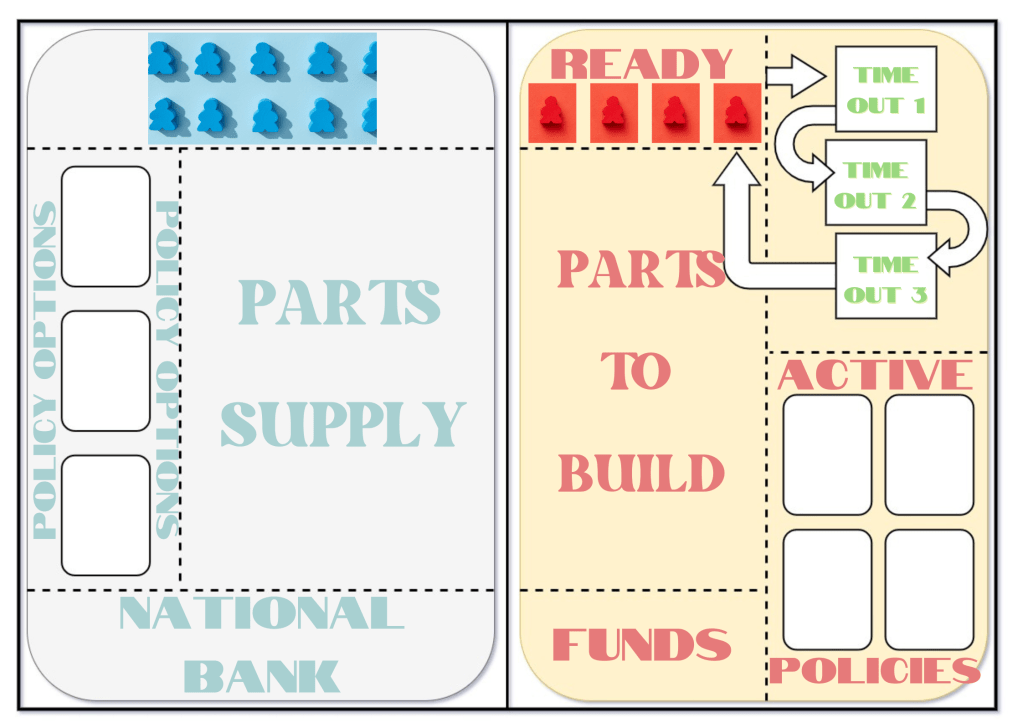
- 2 Player Mats, divided into “supply” half and “hangar” half, with a points tracker along the edge
- 50 reversible coin tokens (Dollars on one side, Roubles on the other)
- 50 Worker meeples
- 2 “Workshop” player aid cards indicating the money cost, manpower requirement, and point value for each type of part.
- 2 identical sets of Rocket Parts, and 2 Launch Pads.
- 2 separate Policy Decks.
- An “iron curtain” play screen
- 2 wooden point tracker tokens.
- ~12 Victory cards.
Player mats: The “supply” includes space for inactive Workers, unpurchased Parts, a national Bank, and a display of 3 “policy options”. The “hangar” includes space for current Funds, purchased Parts, and the Worker time-out track and “Ready Room”.
THE AIM
In this game, two players start with asymmetrical resources and hidden play space. They compete over a series of turns to build an effective construction engine that will let them purchase and add parts to their rocket. When one player declares they are ready to launch, both rockets are put to the test by shaking the table – whatever remains is what will count in the final scoring!
SET UP
To set up, players should sit opposite one another at the table. Each player is given a player mat, a Launch Pad, their point tracker token, a set of Parts, 25 Worker meeples and 25 coin tokens, and their Policy Deck.
The US player adds 10$ to the funds in their Hangar, and 6 Workers to the Ready Room. The Soviet Union player adds 6₽ and 10 Workers. All remaining resources are placed on the relevant spaces on the Supply side. The policy decks are shuffled and placed face up on the deck space, and two cards are drawn and added to fill out the “policy options” display. Point tracker markers are placed on point trackers.
The Victory Cards should be shuffled and 2 dealt to each player, who may look at these secretly. Victory Cards contain comparative goals (e.g.: ‘your rocket is the tallest’; ‘your rocket has the most orange parts’; ‘your rocket has the most thrusters’) and a number of points available for achieving that goal.
Finally, set up the Iron Curtain screen to separate the two play areas, obscuring view. Launch Pads should be placed near to the screen to fully obstruct spying.
TURNS
At the beginning of a player’s turn, they move any Workers on the Time-out Track one space along that track. If any leave the track, they are returned to the Ready Room.
The player may then take any or all of the following actions in the order below:
- Purchase Parts. Take one or more Parts from the Supply and add them to your Parts store in your Hangar, paying the relevant cost in Coins back to your National Bank.
- Build Parts. Using Parts stored in your Hangar, build these onto your Rocket. Each Part has a Manpower requirement to build, and this number of Workers must be sent to the Time-Out Track. The only rules about building placement are that Parts can touch the Launch Pad, but not the table, and that once a Part is placed, it cannot be moved. For each Part built, a set number of Points (shown on your Workshop card) is added on the Point Tracker.
- Use any Active Policies in your Hangar. Policy cards come in 3 different colours, matching those of the Rocket Parts. Active Policies are once-per-turn abilities which allow the player to add, redistribute, or change their current resources. Most of these Policies will relate to gaining or trading money, Parts, or Workers. (See the Appendix for examples).
If a player does not wish to use a given Policy this turn, they can choose to instead discard it, removing it from the game permanently, and in return gain a Part of matching colour from their Supply to their Hangar for free. - Spend points to purchase new Policies. Each Policy card has a cost: by reducing their Points by the relevant amount, the player can buy a Policy shown in their “Policy Options” display and add it to their Active Policies, drawing a new card from the Policy Deck to refresh the display.
SUMMARY
Players continue taking hidden turns as described above. Certain Policy cards may allow the players to learn information about their opponent’s game, for example using Espionage, Sabotage or Subterfuge.
The game end is triggered when one player declares “We’re going to Launch!” Their opponent may then take one additional turn before launch testing.
In turn, both players shake the table! Any parts which fall from either rocket are immediately discarded and won’t be scored. When the test is concluded, players score points for each of their Victory Cards they achieved, adding these to the current score on their Point Tracker. Scores are compared, and the player with the highest wins!
WHAT’S UNIQUE ABOUT THIS GAME?
Astro vs Cosmo takes on the space race through a whimsical lens, combining game mechanics that aren’t often seen together. In doing so, it makes a play experience that will appeal to both heavy-strategy gamers and those who prefer more interactive or creative games.
- Hidden turns create an atmosphere of risk and uncertainty, with an optional element of espionage and sabotage
- Strategy combines with luck, practical skills and dexterity
- Unique “final launch test” where both players shake the table
APPENDIX
Parts: It is important to note that these “Rockets” won’t be accurate or symmetrical. They are very much abstract and can be as topsy-turvy as the player wishes.
These are the Parts that we picture potentially being in the game.
“Core” pieces (typically found in the central trunk of the structure):
– Engine Block: Larger, solid and square
– Cabin: Smaller cube
– Fuselage: Solid cylinder
– Separators: Multiple shallow cylinders which can be stacked to extend the rocket’s height
– Capsule: a flat-topped dome or truncated pyramid
– Nose cone: a rounded hollow cone
“Exterior” pieces (typically found attached around the trunk of the structure):
– Fuel Tanks: Narrow cylinders with domed top
– Thrusters: Angled cone with chunky disc at base
– Fins: flat triangles/curved fin shapes
– Shields: flat panels
Policies: here are some ideas for Policy cards that could be found in one or both Policy Decks:
– Free University: once per turn, gain 2 additional Workers to your Ready Room.
– Corporate Investors: once per turn, gain 2 coins to your Funds.
– Economic Strictures: if no workers enter your Ready Room this turn, gain 6$ at the end of the turn.
– Recruitment Campaign: once per turn, spend 1 coin to gain a Worker.
– Scientific Espionage: Look at your opponent’s Rocket. Choose one Part they have built and gain that Part for free from your Supply.
– Political Espionage: Look at your opponent’s Policy Options. Choose one Policy to steal and add it to your Active Policies.
– Subterfuge: Place 2 Workers in Time-out and swap a Part from your Supply with a Part from your opponent’s Supply.
– Sabotage: Place 3 Workers in Time-out and steal a Part from your opponent’s Rocket.
– Innovation: Place 5 Workers in Time-out and gain a Part of your choice to your Hangar.
– Patriot propaganda: once per turn, move any Workers from Time-out 2 to Time-out 3.
– Public demonstrations: if you added a Part to your rocket this turn, gain 1 Worker to your Ready Room.
Legacy potential: The game could be sold with two sets of stickers – one for each side – with victory meaning a player can add a sticker onto one of their rocket’s Parts. These stickers could represent “upgrades” or components which could feature on Victory cards for an expansion.
 Big Crow Games