

Thank you to our awesome friend Will for being a guest this episode! Watch the video on Youtube. Below is a description of our surreal abstract co-op game, MindMap.
THE ELEVATOR PITCH
MindMap is a surreal 2-player co-operative game based around understanding one anothers’ mental connections. A “Guide” player must help their co-player, the “Explorer”, navigate a “map” of concentric rings with the use of clues which connect icons and ideas.
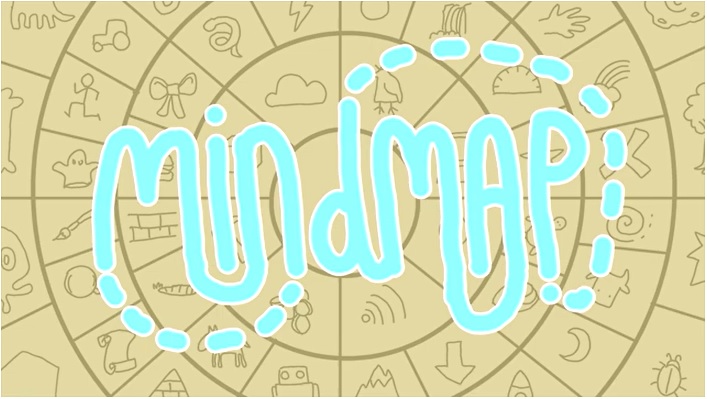
THE LOOK
The game aesthetic leans heavily on the imagery of maps, from colour and illustration style to iconography. Colours in the game are mostly off-white, tan, and “landscape” colours found on old and modern maps.
The main component is a large cardboard “map wheel” which consists of four interlocking, concentric rings which can rotate independently of each other. Each ring has a number of icons around its circumference, a number which increases with size of the ring (e.g. four icons for the innermost ring, 32 icons for the outermost ring).
Icons are simple but distinct and figurative enough to be identifiable by a chosen name. Examples might be a wave icon; a compass rose; a knife; four squares representing a box or window frame; an eye; a bottle; etc.
The other components of the game are;
- A smaller, handheld Map Wheel for the Guide player.
- A deck of Path Cards.
- A Compass token.
Each Path Card contains a set of four icons connected by arrows, showing the eventual “path” which the players want to assemble in the map wheel.
THE AIM
Only the Explorer player is allowed to touch the large Map Wheel. Only the Guide player may look at the Path Cards and smaller wheel. Together, with the Guide giving clues, they try to assemble the wheel so that each icon on the Path Card is touching the icons it is connected to. For example if a Path Card connects the waves, star, teacup, and book, those four icons should form a connected path in final Map Wheel.
SET UP
The Guide player takes the Path Deck and the miniature handheld Map Wheel. The large Map Wheel board is constructed in the centre of the table and rotated at random. The Compass token is placed anywhere on the central wheel.
The Guide player draws a Path Card, looks at it secretly, and rotates their handheld wheel to their satisfaction. There may be more than one precise configuration which is technically “correct” according to the Path Card. The Guide can take some time to get their wheel exact, or can choose to edit it as they play.
The Explorer puts aside an additional number of Path Cards depending on the difficulty level of the game. A standard (“easy”) game has 7 turns, so 7 cards would be put aside and the rest of the deck returned to the box.
TURNS
Each turn, the Guide player gives a clue to the Explorer. The clue must be one word. The Guide aims to draw connections between icons which should be touching between two sections of the Map Wheel. On the first turn, they give a clue which relates the inner wheel (wheel 1) to its neighbour (wheel 2). They do not need to give clues which relate to icons on the Path Card. For example, if the Guide wants to get the Explorer to rotate wheel 2 so the waves (on wheel 1) and star (on wheel 2) are touching, they could give the clue “sextant”. Alternatively, they could look at two other icons which touch in the “correct” map. For example, they could indicate the hammer and the horseshoe by saying “smith”. The Guide may even give a clue which they think connects multiple pairs of icons within the “correct” map.
The Explorer must rotate the wheel (or chooses not to), and indicates the end of the turn by saying “done”. At this point, whether or not their choice was correct, one of the turn tracker cards is discarded. If the choice was correct, i.e. the two icons on wheel 1 and 2 as indicated by the guide’s Path Card are touching, the guide moves the Compass token to any space on Wheel 2. This indicates that the next clue will be to connect wheel 2 and wheel 3.
SUMMARY
The players continue taking turns as above. If the Compass token reaches the outer wheel within the chosen number of turns (i.e. before the tracker cards run out), then the players win!
WHAT MAKES THIS GAME UNIQUE?
This game tries to help two players explore one anothers’ mental “wavelengths” by using connections on a shifting map. It’s an interactive and abstract co-op game that emphasises shared understanding.
 Big Crow Games